Unifying Athlete Wellness: From Isolated Support to a Structured Growth System
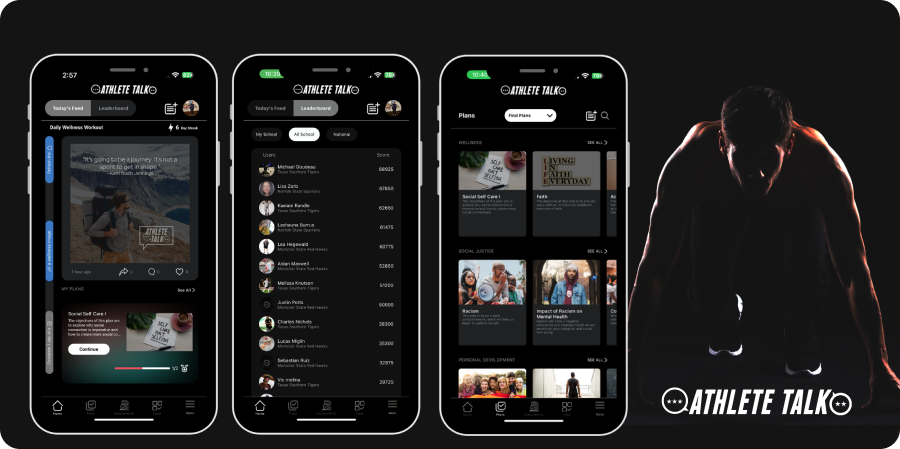
AthleteTalk is a structured mental wellness platform built for schools, coaches, and student athletes who struggle with fragmented mental health support systems. Instead of relying on occasional check-ins, scattered motivational content, or disconnected wellness apps, AthleteTalk brings assessments, guided plans, progress tracking, and team-based accountability into one cohesive ecosystem designed for engagement, visibility, and long-term development.
THE PROBLEM
When Athlete Support Becomes Fragmented
Schools, academies, and sports programs increasingly recognize the importance of athlete mental wellness — but the systems supporting it remain scattered. Conversations happen offline, assessments are occasional, progress tracking is inconsistent, and coaches often lack structured visibility into athlete wellbeing.
This creates structural gaps:
- Mental health support limited to reactive conversations instead of proactive systems
- No centralized assessment or progress tracking framework
- Coaches relying on intuition instead of measurable insights
- Athletes hesitant to speak openly in traditional team settings
- Lack of continuity between sessions, feedback, and follow-ups
- Disconnected tools for communication, tracking, and guidance
For many institutions, the problem wasn’t awareness —
it was the absence of a structured, scalable system that connects assessment, action, and accountability.
MY APPROACH
Understanding Athlete Behavior, Not Just Building a Platform
Designing AthleteTalk required more than creating a clean interface.
It required understanding how athletes think, express, and seek support — especially when it comes to mental wellbeing.
Since AthleteTalk connects athletes, mentors, and structured self-reflection tools in one ecosystem, the biggest risk wasn’t visual design — it was misaligning the product with real emotional and behavioral patterns.
I followed a structured research approach to uncover:
- Real emotional barriers athletes face
- How support conversations naturally happen
- Gaps between intention to seek help and actual action
Primary Research
- Athlete & Coach Conversations
Spoke with athletes across different levels and a few coaching professionals to understand:- When athletes feel most mentally vulnerableWhy they hesitate to speak openlyWhat type of support feels safe vs intimidating
- Behavior Mapping
Mapped common scenarios:- Performance pressure before competitions
- Post-loss emotional states
- Injury recovery periods
- Academic and career uncertainty
- Current Support Flow Analysis
Studied how institutions currently handle athlete wellbeing:- Informal check-ins
- Occasional workshops
- One-time counseling sessions
- WhatsApp-based communication
Secondary Research
- Mental Wellness Platforms & Community Apps
Studied platforms focused on therapy, journaling, and community discussion to understand:- How anonymity affects participation
- How guided prompts increase reflection
- Where friction reduces engagement
- Sports Psychology Content Review
Analyzed publicly available sports psychology frameworks to understand:- Stress cycles in competitive environments
- Performance anxiety triggers
- Motivation drop-off patterns
Why Start With Structured Self-Reflection?
Athletes rarely begin by booking a session.
They begin with hesitation.
Instead of forcing direct communication, AthleteTalk was positioned to:
- Enable private self-assessment first
- Provide guided reflection prompts
- Build psychological safety gradually
If the system works for high-pressure athletes,
it will naturally work for younger or early-stage athletes.
What the Research Revealed
Three key insights shaped the entire direction:
1. Silence Was the Biggest Risk
Athletes often don’t speak until pressure becomes overwhelming.
Reasons included:
- Fear of judgment
- Concern about team perception
- Not knowing how to articulate emotions
The problem wasn’t lack of support — it was lack of safe entry points.
This led to designing low-friction, private starting experiences.
2. Support Without Continuity Doesn’t Create Progressosts
Most support systems were reactive.
A bad match → conversation
An injury → counseling session
A visible breakdown → intervention
But without:
- Ongoing tracking
- Behavioral patterns
- Emotional trend visibility
Progress couldn’t be measured.
Athletes needed a continuous journey, not isolated sessions.
3. Coaches Needed Insight Without Violating Trust
Coaches care deeply —
but they lack structured visibility.
They needed:
- Aggregate wellbeing signals
- Trend indicators
- Non-invasive insights
Without accessing private conversations or breaking trust.
This insight shaped how data transparency and role-based visibility were structured.
Turning Insights Into Direction
These findings shaped three core design principles:
1. Psychological Safety First
Every interaction should feel:
- Private
- Controlled
- Non-judgmental
Before expecting athletes to open up.
2. Continuity Over One-Time Interaction
Design for:
- Ongoing tracking
- Behavioral patterns
- Progress visualization
Not just one-off conversations.
3. Insight Without Intrusion
Provide coaches and institutions with:
- Pattern-based visibility
- Risk indicators
- Actionable signals
Without exposing personal reflections.
THE SOLUTION
Designing One Structured Support System Instead of Isolated Interactions
The research made one thing clear:
AthleteTalk didn’t need more motivational content — it needed a structured foundation.
Most existing solutions treated mental wellness as:
- Journaling apps
- Chat platforms
- Content libraries
- Or occasional counseling sessions
I wanted AthleteTalk to feel like one continuous developmental journey — not disconnected features stitched together.
I brought a behavior-first, system-thinking approach, while stakeholders contributed institutional and operational context from schools and sports programs.
This collaboration was critical —
UX ensured psychological safety and clarity, while stakeholders ensured alignment with real athletic environments.
Neither perspective alone could have created a scalable support platform.
Key Structural Decisions
Instead of adding features, I focused on reducing emotional and operational friction.
Core product decisions:
- Consolidated support into three structured pillars — Assess, Reflect, Progress
- Designed role-based architecture (Athlete, Coach, Admin)
- Introduced guided assessment flows instead of open-ended forms
- Built progress tracking with visual milestones and streak systems
- Created a private reflection space with optional sharing controls
- Designed aggregated wellbeing dashboards for coaches
- Standardized interaction patterns across modules
- Built reusable card-based components for scalability
Rather than designing chat, assessment, and tracking separately,
I treated the platform as one behavioral ecosystem with shared context.
This ensured users never felt like they were switching modes — even when moving between reflection, assessment, and progress tracking.
Translating Behavioral Journeys Into Product Structure
I mapped real-life athlete emotional cycles first:
Stress → Reflection → Guidance → Reinforcement → Growth
Then aligned each step to the platform.
This led to:
- Structured onboarding assessments
- Daily guided prompts
- Progress visualization dashboards
- Streak-based motivation loops
- Coach insight panels
- Role-based data visibility controls
Every screen answered one question:
“What does the athlete need right now?”
Not
“Which feature should they explore?”
That shift simplified engagement and reduced hesitation.
Testing, Learning, Refining
Instead of launching fully built modules, I worked iteratively with feedback cycles involving:
- Student athletes
- Coaches
- School administrators
- Internal stakeholders
Round 1 Findings
- Too many prompts felt overwhelming
- Athletes unsure where to start
- Coaches needed clearer aggregated insights
Round 1 Changes
- Introduced progressive onboarding
- Simplified daily task visibility
- Reduced optional inputs
- Designed summary-level dashboards for coaches
Round 2 Findings
- Engagement dropped after initial usage
- Gamification felt superficial
- Privacy expectations needed clarity
Round 2 Changes
- Added streak-based reinforcement
- Improved milestone celebrations
- Clarified data visibility rules
- Strengthened role-based permissions
Round 3 Validation
- Higher consistency in daily reflections
- Improved clarity in onboarding
- Coaches reported better insight without breaching trust
The experience began to feel structured and safe — which was the primary goal.
Designing for Scale, Not Just a Single Team
AthleteTalk wasn’t meant for one classroom or one team.
It needed to scale across:
- Multiple schools
- Multiple teams
- Different age groups
- Varying coaching structures
If the foundation wasn’t flexible, complexity would overwhelm the system.
So I focused on:
- Modular architecture
- Reusable UI components
- Extensible role-based permissions
- Scalable reporting layers
- Consistent mobile-first design
This allowed new features and teams to be added without redesigning the core experience.
When Institutional Needs Meet Athlete Needs
The Mid-Project Constraint
As discussions evolved, institutions requested:
- More reporting
- More data visibility
- Risk flagging mechanisms
- Performance correlations
These were operationally important but risked compromising psychological safety.
Initially, this felt like a conflict.
But instead of exposing more raw data, I reframed the question:
How might we provide insight without violating trust?
Finding the Balance
My approach:
- Aggregate patterns instead of individual entries
- Surface trend indicators instead of raw emotional logs
- Use color-coded risk signals
- Allow athletes to control sharing settings
- Keep sensitive reflections private by default
Rationale:
- Protect athlete trust
- Provide actionable signals to coaches
- Maintain emotional safety
- Support institutional accountability
This ensured AthleteTalk could serve both individuals and institutions — without fragmenting the experience.
The Result
What we built wasn’t just a mental health app.
It became:
- A structured wellbeing journey
- A trust-centered communication system
- A scalable school-wide support framework
- A measurable behavioral growth platform
Instead of relying on occasional check-ins, institutions gained a continuous, guided system — designed to support athletes confidently and responsibly.
CHALLENGES & LEARNINGS
What This Project Taught Me
Designing AthleteTalk wasn’t just about building a mental wellness app —
it was about designing a trust-based system that schools, coaches, and young athletes would rely on consistently.
Working on a role-based, emotionally sensitive platform exposed me to a different kind of complexity:
privacy expectations, institutional accountability, behavioral engagement, and long-term adoption.
If I could redo this project, here’s what I’d approach differently.
1. Push for Deeper Athlete-Led Research
Early insights came from structured conversations with coaches and institutional stakeholders.
While valuable, they represented leadership perspectives.
Athletes — especially younger ones — expressed themselves differently in real usage scenarios.
In hindsight, I would push for:
- more diary studies
- longitudinal behavior tracking
- anonymous testing groups
Because emotional behavior in real contexts often differs from interview responses.
2. Validate Engagement Loops Earlier
We initially focused on building structured assessments and tracking systems.
But long-term engagement depends on emotional reinforcement.
Some early users dropped off after onboarding because:
- motivation wasn’t reinforced consistently
- streak systems weren’t prominent enough
- progress visualization needed stronger feedback
If redesigned today, I’d prototype engagement mechanics earlier and test motivation patterns more rigorously.
Consistency matters more than feature depth.
3. Avoid Over-Structuring Emotional Expression
When designing structured reflection systems, there’s a risk of making emotional experiences feel mechanical.
Some early flows felt too linear.
I learned that:
- emotional support needs flexibility
- not every journey should feel predefined
Now I balance structure with open-ended options more intentionally.
Guidance should feel supportive — not prescriptive.
4. Privacy Architecture Is a UX Decision
In platforms involving minors and mental health, privacy isn’t a backend detail — it’s a core experience driver.
Initially, data visibility logic felt like a technical constraint.
But I realized:
- clarity around “who sees what” directly affects participation.
- Designing role-based transparency systems early would have reduced iteration cycles.
- Trust design should start on day one.
5. Institutional Requirements Can Create Tension
Schools requested:
- risk alerts
- behavior tracking
- reporting visibility
These were operationally necessary but emotionally sensitive.
At times, this felt like a conflict between business needs and user safety.
I learned to reframe constraints as design challenges:
How do we provide insight without exposure?
How do we measure wellbeing without surveillance?
That balance defined the product’s credibility.
6. Collaboration Builds Context
This project required close alignment with:
- educators
- coaches
- product stakeholders
- engineers
Many insights came from conversations, not screens.
Some of the most impactful decisions — like aggregated dashboards instead of raw reflection logs — came from cross-functional discussions.
I learned that:
In emotionally sensitive systems, collaboration is not optional — it’s essential.
7. Engagement Is Harder Than Usability
Unlike productivity tools, wellness platforms compete with:
- emotional resistance
- busy schedules
- social hesitation
Even a well-designed interface doesn’t guarantee consistent usage.
Now I evaluate success through:
- daily return rates
- reflection completion rates
- streak consistency
- coach dashboard engagement
Without measurable engagement, wellness tools become passive.
8. Behavioral Platforms Are Never Static
Emotional patterns evolve.
Institutional policies evolve.
Athlete expectations evolve.
AthleteTalk isn’t a finished product —
it’s a continuously adapting behavioral system.
I learned to design for:
- scalable permissions
- adaptive content flows
- modular role expansion
- future reporting layers
Because behavioral products must grow without compromising trust.
AthleteTalk reshaped how I approach UX in sensitive domains.
Not as feature delivery.
Not as interface polish.
But as trust architecture — built thoughtfully, iterated carefully, and scaled responsibly.
Final Thoughts
Looking back at AthleteTalk, this wasn’t just a mobile app design project.
It was my first time designing a trust-centered ecosystem —
where athletes, coaches, and institutions had to operate within the same system without compromising psychological safety.
What started as “building a mental wellness platform” slowly became
designing behavioral journeys, role-based transparency, and long-term engagement systems.
This project reshaped how I think about UX.
Not as screens.
Not as interfaces.
But as operational problems solved through structure and clarity.
3 Core Principles
Trust is strategy, not interface
At the beginning, it was tempting to focus on features:
- assessments
- dashboards
- reflection tools
- gamification
But athletes didn’t struggle because tools were missing.
They struggled because they didn’t feel safe expressing vulnerability.
No amount of UI polish can fix broken trust.
The real solution was:
- creating safe entry points
- designing private-first interactions
- building transparent data visibility rules
- separating insight from intrusion
Designing around psychological safety instead of features changed everything.
This taught me to design trust before functionality.
Structure enables emotional consistency
Mental wellness can’t rely on occasional conversations.
It needs continuity.
If we had designed based only on assumptions about motivation, we would have shipped something that looked supportive but didn’t drive consistent engagement.
Iteration helped us:
- simplify reflection flows
- reduce emotional friction
- strengthen streak reinforcement
- clarify role-based visibility
Each refinement removed hesitation and increased clarity.
Good UX in sensitive domains isn’t about adding inspiration —
it’s about reducing resistance.
Impact in behavioral products is measured by engagement
Early in my career, I might have judged success by:
“Does it look clean?”
“Does it feel modern?”
But wellness platforms demand deeper metrics.
Success means:
- consistent daily engagement
- improved reflection completion
- clearer coach visibility
- increased athlete participation
- sustained usage over time
Because in behavioral systems,
design directly influences action.
Without measurable engagement, support systems fade.
With measurable engagement, they become institutional assets.
Closing Note
AthleteTalk continues to evolve, but the foundation we built allows it to scale responsibly — across teams, schools, and age groups — without compromising trust.
And that’s what I’m most proud of.
Not just a mobile interface —
but a structured, safe system that athletes can rely on when they need guidance.
This project reminded me why I value UX deeply:
- Transforming complex emotional challenges
- into structured, dependable systems
- that quietly support people when it matters most.