Replacing Plastic Water Jars with a Smart, Sustainable Corporate Hydration System
Designed a zero-plastic, touch-free stainless steel water solution that reduces recurring operational costs while improving water transparency and ESG alignment for modern workplaces.
THE PROBLEM
When Corporate Hydration Becomes an Operational Burden
Modern offices still depend on plastic water jars & traditional dispensers to manage daily drinking water needs. What appears simple on the surface creates hidden operational strain — frequent jar deliveries, storage space management, manual vendor coordination, and rising recurring costs.
This leads to systemic friction:
- Dependency on third-party water suppliers for daily operations
- Accumulation of plastic waste and microplastic exposure risks
- Transportation emissions from repeated jar deliveries
- No real-time visibility into TDS, pH, or water quality
- Increasing long-term operational expenses
For many businesses, the issue wasn’t access to water — it was the outdated system supporting it.
MY APPROACH
Understanding Operational Reality, Not Just Product Features
To design Rolan R-200 effectively, I needed to understand why corporate hydration systems fail operationally — not just how water purifiers function technically.
Since Rolan replaces traditional jar-based systems with a fully managed stainless steel solution, the risk wasn’t engineering complexity — it was resistance to changing long-standing infrastructure habits.
I followed a mixed-methods approach to uncover:
- Real operational friction in offices
- Hidden costs behind jar dependency
- Environmental and ESG pressures
- Adoption barriers for infrastructure upgrades
Primary Research
- Stakeholder & Operations Discussions
Conversations with facility managers, admin teams, and business decision-makers to understand daily hydration logistics, vendor coordination, and maintenance issues.
- Workflow Mapping
Mapped how water jars are ordered, stored, replaced, and monitored across offices to identify inefficiencies and hidden effort
- On-Site Observation
Studied real workplace setups to understand:- Storage constraints
- Usage patterns
- Hygiene behavior
- High-traffic consumption areas
Secondary Research
- Market & Competitor Analysis
Studied traditional jar suppliers and commercial RO systems to understand:- Cost structures
- Maintenance gaps
- Water recovery efficiency
- Energy consumption models
- Sustainability & ESG Review
Analyzed corporate sustainability commitments to identify alignment opportunities:- Plastic reduction goals
- Carbon footprint reduction
- CSR positioning
Why Corporate Workspaces First?
Corporate offices and industrial facilities were high-consumption environments.
They managed:
- 150–200 employees per floor
- Daily water logistics
- Vendor contracts
- Operational accountability
If the solution worked at that scale, it would naturally extend to smaller setups.
Budget and time constraints limited large-scale quantitative studies, so focus remained on high-impact environments.
What the Research Revealed
Three key insights shaped the product direction:
1. Plastic Dependency Was the Real Bottleneck
Organizations weren’t struggling with access to water —
they were struggling with the system delivering it.
- Water ordering happened externally
- Storage happened internally
- Monitoring was manual
- Quality verification was unclear
We don’t know the quality — we just trust the vendor.
The problem wasn’t purification technology — it was infrastructure dependency.
2. Hidden Costs Outweighed Visible Costs
Jar systems appeared simple, but created:
- Recurring vendor expenses
- Transport emissions
- Storage inefficiencies
- Administrative coordination
The visible cost per jar was small.
The operational cost over time was not.
Companies didn’t need cheaper water —
they needed predictable, optimized hydration infrastructure.
3. Transparency Builds Institutional Trust
Most systems did not show:
- Live TDS
- pH levels
- Temperature readings
Water quality existed, but it wasn’t visible.
Businesses didn’t want more maintenance calls —
they wanted measurable assurance.
This insight led to prioritizing digital monitoring as a core UX layer.
Turning Insights Into Direction
These findings shaped three core design principles:
1. Infrastructure-First Design
Design hydration as a managed system, not a consumable product.
- Tap water filtration instead of jar replacement
- Fully managed AMC instead of reactive maintenance
- Durable stainless steel over disposable plastic
2. Measurable Transparency
Ensure users can see:
- What they’re drinking
- How pure it is
- When performance changes
Real-time TDS, pH, and temperature visibility reduced uncertainty.
3. Scalable Sustainability
Support high-consumption environments without adding operational burden by:
- Zero CAPEX onboarding
- OPEX-based pricing
- Plastic-free architecture
- Energy-efficient design
Sustainability had to simplify operations — not complicate them.
THE SOLUTION
Designing Hydration as a Managed System, Not a Water Machine
The research made one thing clear:
Rolan R-200 didn’t need to be a better water cooler — it needed to replace an outdated hydration ecosystem.
Most existing solutions treated water as a consumable dependency.
Jars were delivered, replaced, stored, and forgotten.
I wanted R-200 to feel like infrastructure — predictable, measurable, and sustainable.
I brought a systems-thinking approach, while the founders and operations team contributed deep industry knowledge and technical expertise.
This collaboration was critical —
UX shaped clarity and adoption, while stakeholders ensured feasibility and scalability.
Neither perspective alone would have created a viable solution.
Key Structural Decisions
Instead of optimizing jar logistics, I focused on eliminating the dependency entirely.
Core product decisions:
- Replaced jar-based supply with direct tap-water filtration
- Integrated RO + UV + Alkaline purification into a single system
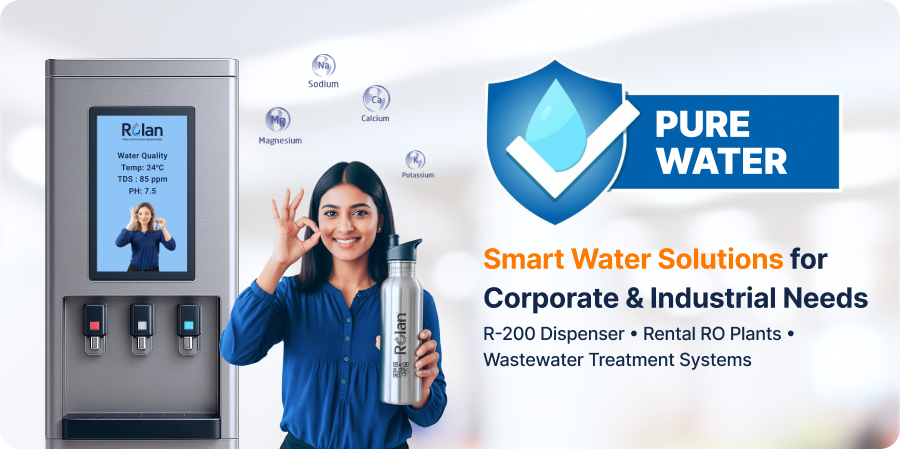
- Introduced real-time digital display (TDS, pH, Temperature)
- Built touch-free dispensing to improve hygiene
- Shifted from CAPEX-heavy purchase model to OPEX-based pricing
- Designed stainless steel architecture for durability and reuse
- Included full AMC coverage to remove operational burden
Rather than designing a machine, I designed a managed hydration system with accountability and transparency.
This ensured companies weren’t “buying equipment” —
they were adopting a long-term solution.
Translating Operational Workflows Into Product Structure
I mapped real-life corporate hydration workflows first:
Order → Store → Replace → Monitor → Maintain → Repeat
Then redesigned the system to eliminate most of these steps.
This led to:
- No jar storage requirements
- No delivery coordination
- No manual quality checks
- No filter management burden
Every design decision answered one question:
“How do we remove friction from daily hydration operations?”
Not
“How do we improve the dispenser?”
That shift simplified the entire system.
Testing, Learning, Refining
Instead of finalizing everything upfront, we iterated through structured validation.
We tested early concepts with:
- Facility managers
- Corporate decision-makers
- Operations teams
- Internal service staff
Round 1 Findings
- Resistance to replacing jar systems
- Concerns about water quality reliability
- Questions about cost comparison
Round 1 Changes
- Added live water quality visibility
- Created clear cost-per-litre comparison models
- Strengthened AMC and service transparency
Round 2 Findings
- Concerns around maintenance responsibility
- Questions about scalability for larger offices
- Doubt about long-term durability
Round 2 Changes
- Clarified zero maintenance responsibility for clients
- Strengthened stainless steel durability positioning
- Highlighted scalability for 150–200 employees per unit
Round 3 Validation
- Higher confidence in cost savings
- Improved trust due to visible water metrics
- Stronger ESG alignment discussions
Businesses reported:
- Reduced plastic waste
- Simplified operations
- More predictable monthly hydration expenses
The solution started to feel dependable — which was the core objective.
Designing for Scale, Not Just Replacement
One major challenge was ensuring R-200 could scale beyond single installations.
Corporate environments evolve with:
- Growing employee counts
- Multiple office locations
- Stricter ESG expectations
- Higher compliance standards
If the system lacked flexibility, adoption would slow.
So I focused on:
- Modular servicing structure
- Flexible capacity deployment
- Clear performance reporting
- Standardized maintenance workflow
- Long-term durability planning
This ensured expansion would not require redesigning the entire system.
When Business Needs Meet Sustainability
The Mid-Project Constraint
As adoption discussions grew, new business requirements emerged:
- Faster onboarding
- Lower upfront barriers
- Stronger ESG positioning
- Clear ROI storytelling
Initially, this risked over-complicating the communication.
Instead of adding complexity, I reframed the problem:
How might we increase adoption without increasing operational burden?
Finding the Balance
My approach:
- Zero CAPEX onboarding
- Predictable OPEX pricing
- Fully managed AMC support
- Visible water quality metrics
- Clear sustainability narrative
Rationale:
- Remove financial hesitation
- Reduce operational fear
- Increase institutional trust
- Align with CSR and ESG goals
This allowed R-200 to serve both cost-driven businesses and sustainability-driven enterprises without fragmenting the offering.
The Result
What we built wasn’t just a purification unit.
It became:
- A plastic-free hydration infrastructure
- A transparent water quality system
- A predictable cost model
- A sustainability-aligned corporate solution
Instead of managing jar deliveries and storage, businesses could focus on operations — while hydration ran seamlessly in the background.
CHALLENGES & LEARNINGS
What This Project Taught Me
Designing Rolan R-200 wasn’t just about building a water purification unit —
it was about redesigning an existing infrastructure system that businesses had relied on for years.
Working on a physical product with operational and sustainability implications exposed me to real-world complexity: resistance to change, cost sensitivity, service accountability, and long-term scalability.
If I could redo this project, here’s what I’d approach differently.
1. Push for Broader External Validation
Early discussions involved facility managers and decision-makers already familiar with hydration systems.
While valuable, they represented structured corporate environments.
In hindsight, I would push for:
- more diverse workspace validation
- industrial site testing
- mid-size office comparisons
Because usage patterns vary significantly across environments.
2. Communicate ROI Earlier
We focused heavily on sustainability and system efficiency.
But cost clarity drives adoption.
Some early conversations stalled because businesses needed clearer comparisons between:
- jar-based monthly costs
- transport overhead
- long-term operational savings
If redesigned today, I’d introduce ROI modeling and cost calculators earlier in the adoption process.
Clear numbers reduce hesitation.
3. Avoid Engineering-First Thinking
During development, it was tempting to focus on purification layers and hardware specifications.
But businesses don’t buy features —
they buy outcomes.
More purification layers ≠ more trust
What mattered more was:
- visible water metrics
- predictable pricing
- service accountability
I learned to prioritize experience clarity over technical depth.
4. System Design Beats Product Design
Initially, the focus was on designing the unit.
But the real breakthrough came when I treated the solution as an ecosystem:
- machine
- service
- pricing model
- maintenance
- reporting
When everything aligned, the product felt complete.
I now approach physical infrastructure as systems, not standalone devices.
5. Constraints Improve Focus
We faced practical constraints:
- manufacturing limitations
- cost boundaries
- service capacity
- installation logistics
Initially, these felt restrictive.
But they forced sharper decisions:
- simpler architecture
- durable material choices
- clear pricing model
- manageable service scope
Constraints removed unnecessary complexity.
6. Trust Is the Real Product
Unlike SaaS, hydration infrastructure affects health.
Companies needed reassurance around:
- water quality
- maintenance reliability
- long-term durability
I learned that transparency — live TDS, pH, and temperature visibility — builds more trust than marketing claims.
Trust reduces friction more than persuasion.
7. Sustainability Must Be Operationally Practical impact
Businesses care about ESG —
but only if it doesn’t increase workload.
Plastic-free positioning alone wasn’t enough.
The system had to:
- reduce coordination
- simplify maintenance
- predict expenses
Sustainability works when it simplifies operations.
8. Infrastructure Solutions Must Scale
Corporate environments evolve:
- employee counts increase
- locations expand
- compliance expectations rise
A solution that works for one office must work for many.
R-200 isn’t just a product —
it’s a scalable hydration model.
And that perspective reshaped how I approach system-driven design.
Final Thoughts
Looking back at Rolan R-200, this wasn’t just a product design project.
It was my first time redesigning a real-world infrastructure system —
where sustainability, operations, cost, and user trust had to work as one continuous experience.
What started as “designing a water solution” slowly became
designing systems, accountability, and behavioral change.
This project reshaped how I think about UX.
Not as screens.
Not as interfaces.
But as operational problems solved through structure and clarity.
3 Core Principles
Infrastructure is strategy, not equipment
At the beginning, it was tempting to focus on purification layers and hardware improvements.
But companies weren’t struggling because machines were weak.
They were struggling because the hydration system around them was inefficient.
- Jar deliveries
- Storage space
- Vendor dependency
- Manual coordination
No amount of engineering refinement fixes a broken operational model.
The real solution was:
- eliminating plastic dependency
- removing recurring friction
- making quality measurable
- aligning pricing with real usage
Designing around infrastructure instead of equipment changed everything.
This taught me to always redesign the system first, the product second.
Designing around workflows instead of features changed everything.
This taught me to always fix the system first, UI second.
Transparency builds trust faster than features
Corporate buyers don’t purchase water coolers —
they invest in reliability.
- Live TDS visibility
- Clear pH readings
- Predictable OPEX pricing
- Fully managed AMC
These decisions reduced doubt.
If we had relied only on sustainability claims or purification specs, adoption would have been slower.
Iteration helped us:
- simplify communication
- clarify cost structure
- surface measurable benefits
- remove operational fear
Every refinement reduced uncertainty, not added complexity.
Good UX builds confidence before it builds excitement.
Sustainability must simplify, not complicate
Early on, sustainability felt like the headline.
But businesses don’t adopt solutions because they sound green.
They adopt solutions because they make work easier.
Rolan succeeded because it:
- removed jar storage
- eliminated vendor coordination
- reduced plastic waste
- made monthly costs predictable
Environmental impact became a natural outcome of operational efficiency.
That shift changed how I think about sustainable design.
Impact doesn’t come from messaging.
It comes from removing friction at scale.
Closing Note
Rolan R-200 continues to expand across workplaces, but the foundation we built allows it to scale without increasing complexity.
And that’s what I’m most proud of.
Not just a stainless steel unit —
but a hydration system businesses can rely on daily without thinking about it.
This project reminded me why I love UX:
Turning invisible operational problems
into seamless, dependable systems
that quietly improve everyday life.